
The Short Version
- The billing checks the platforms document work on billing data: this quarter against last, one system against another.
- A fee that is wrong everywhere passes every one of them.
- The missing check compares what the system charges with what the client agreed to.
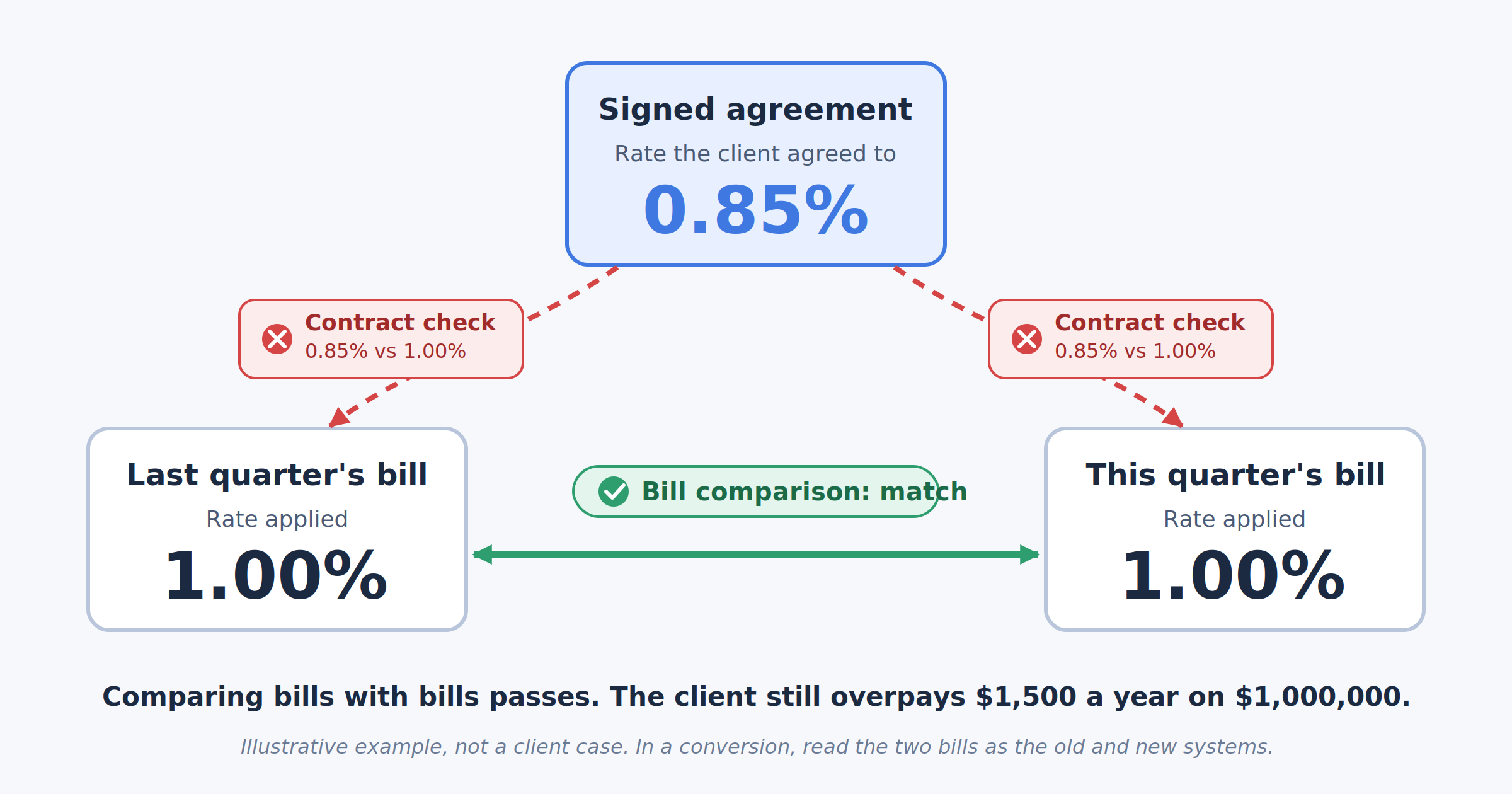
Take a hypothetical client who negotiated a fee of 0.85%. It's on the signed agreement. The billing system charges 1.00%, and it has for years.
Which of your billing checks would catch it?
Check by Check
Here is what the platforms document:
- Compare this quarter with last. Orion's Billing Compare Tool compares two bill instances and flags discrepancies before a bill goes to the client, and Orion describes comparing bills across periods. The rate is 1.00% in both quarters, so there is nothing to flag.
- Confirm billed amounts. Tamarac's Run Billing workflow includes Confirm Billed Amounts: export and examine billing data for missing or inaccurate information. The agreement isn't billing data.
- Reconcile with payments. The same workflow ends with Reconcile Billing History, which compares payments received with billed amounts. The custodian was sent 1.00%, so the two match.
- Run both systems side by side. In a conversion, Black Diamond's implementation plan lists Billing Runs Parallel, then Billing Validation and a billing sign-off. It doesn't say what the validation compares. In the parallel run, if both systems carry 1.00%, they agree.
Where the material says what is compared, it is billing data. None of it describes starting from the signed agreement.
A fee that is wrong everywhere passes every check that compares bills with bills.
Why Comparing Bills Can't Settle It
A comparison finds differences. It can't find an error that never changes.
- The same rate in every quarter: no difference.
- The same rate in the old and new system: no difference.
- The same rate in the billing file and the payment: no difference.
Every check passes because everything agrees. That says nothing about whether the number is right. On $1,000,000, our client overpays $1,500 a year.
These Errors Are Not Exotic
In a 2021 risk alert, SEC examiners reported fee-related deficiencies in most of about 130 exams of SEC-registered advisers. The errors they listed:
- fees that differed from the rates in the agreement
- errors in fee percentages entered by hand
- clients not moved to a new fee schedule
- households not combined for breakpoints
- stale balances after data was lost in a system transition
A 2018 SEC order shows the quiet version. A California adviser with about $212 million under management failed for eight years to apply its fee breakpoints consistently, including combining household accounts. It had overcharged 293 accounts about $304,000, which it refunded with interest.
None of that is specific to acquisitions. But when you take on a firm's clients, you take on its inputs, and you weren't there when they were set up.
Four Kinds of Check
| Check | The question it answers | What the platforms call it |
|---|---|---|
| Load check | Did everything load? Do the totals match? | Black Diamond: Pre-Import Audit and Post-Import Audit |
| Bill comparison | Does this bill match another bill: last quarter's, the old system's, a draft? | Orion: Billing Compare Tool. Black Diamond: Billing Runs Parallel |
| Payment reconciliation | Did the custodian pay what we billed? | Tamarac: Reconcile Billing History |
| Contract check | Does the fee schedule applied match what the client agreed to? | Not described in the material we reviewed |
Some firms do run the contract check. One billing specialist posting lists auditing billing configurations against client agreements. We don't know how many do.
How to Run the Contract Check
Already doing it? Ask whether it covers every client or a sample, and whether it repeats after each acquisition.
Not yet? Start here:
- Build the expected fee for each client from the agreement: fee schedule or tiers, billable assets, household, start date, any caps.
- Compare it with the fee schedule assigned in the billing system and with the last invoice.
- Sort each difference: input error, exception never entered, deliberate change, or timing.
- Start with the largest fees and any agreement with amendments or side letters.
- Set dollar limits up front, and keep exceptions in a register that outlives the project.
In a conversion, run it before the side-by-side billing starts. Otherwise you copy the error into the new system.
Repeat it for every acquisition. Each firm you take on brings its own inputs.
Where DataLux Fits
Acquisitions and platform changes often succeed or fail at the interfaces. DataLux builds the data controls around them: extracting agreement terms, modeling the expected fee, comparing it with the billing setup and keeping the exceptions register.
We're a data engineering firm, not a compliance adviser. We build the check, and you own the policy.
Planning a conversion or an acquisition? Bring us the objective and the current setup, and we'll help define a credible first scope. Contact us here.