01 / PRODUCTION
A prototype has to become operational.
Connect the agent to real systems, test representative cases and put controlled releases around a workflow people will actually use.
FORWARD-DEPLOYED AI ENGINEERING
DataLux designs and delivers AI agents and AI-assisted workflows around the software, data and business rules you already rely on.
Senior engineers work directly with your team—from enterprise integration through evaluation, production rollout and handover.
For enterprise teams, AI product vendors and implementation partners.
WHEN TO BRING US IN
We help when the critical path runs through data access, existing applications, business controls and operational responsibility.
Connect the agent to real systems, test representative cases and put controlled releases around a workflow people will actually use.
Add a bounded backend, data or financial-systems workstream alongside your product, FDE or implementation team.
Use AI for the work that benefits from interpretation; preserve trusted rules, approvals and infrastructure for the rest.
WHAT WE ENGINEER
Three connected engineering disciplines—scoped to your operating environment, not sold as an unlimited AI transformation.
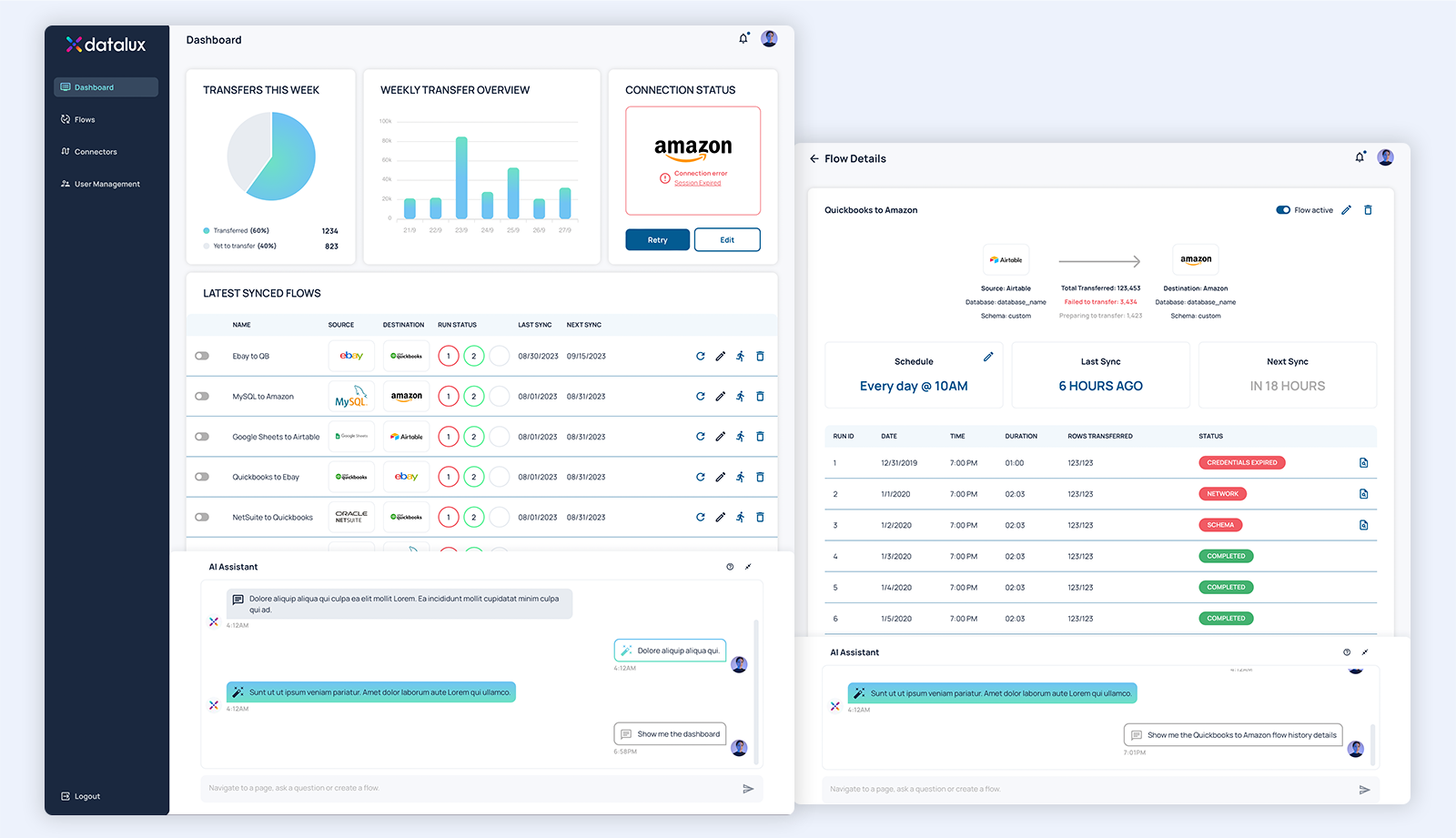
Built by DataLux · existing data integration application
01 / CONNECT
Build secure integrations around your APIs, databases, documents, event streams and identity systems. We preserve permissions, data contracts and the behavior of systems already in production.
02 / CONTROL
Use AI for interpretation and investigation. Let deterministic software enforce calculations, transaction rules and access policies. Route consequential actions through review and approval.
OPERATIONS REVIEW
Reconciliation exceptionPossible reference-format difference. Compare matched fields and supporting evidence before proposing a correction.
Illustrative interface · not a customer system or measured result
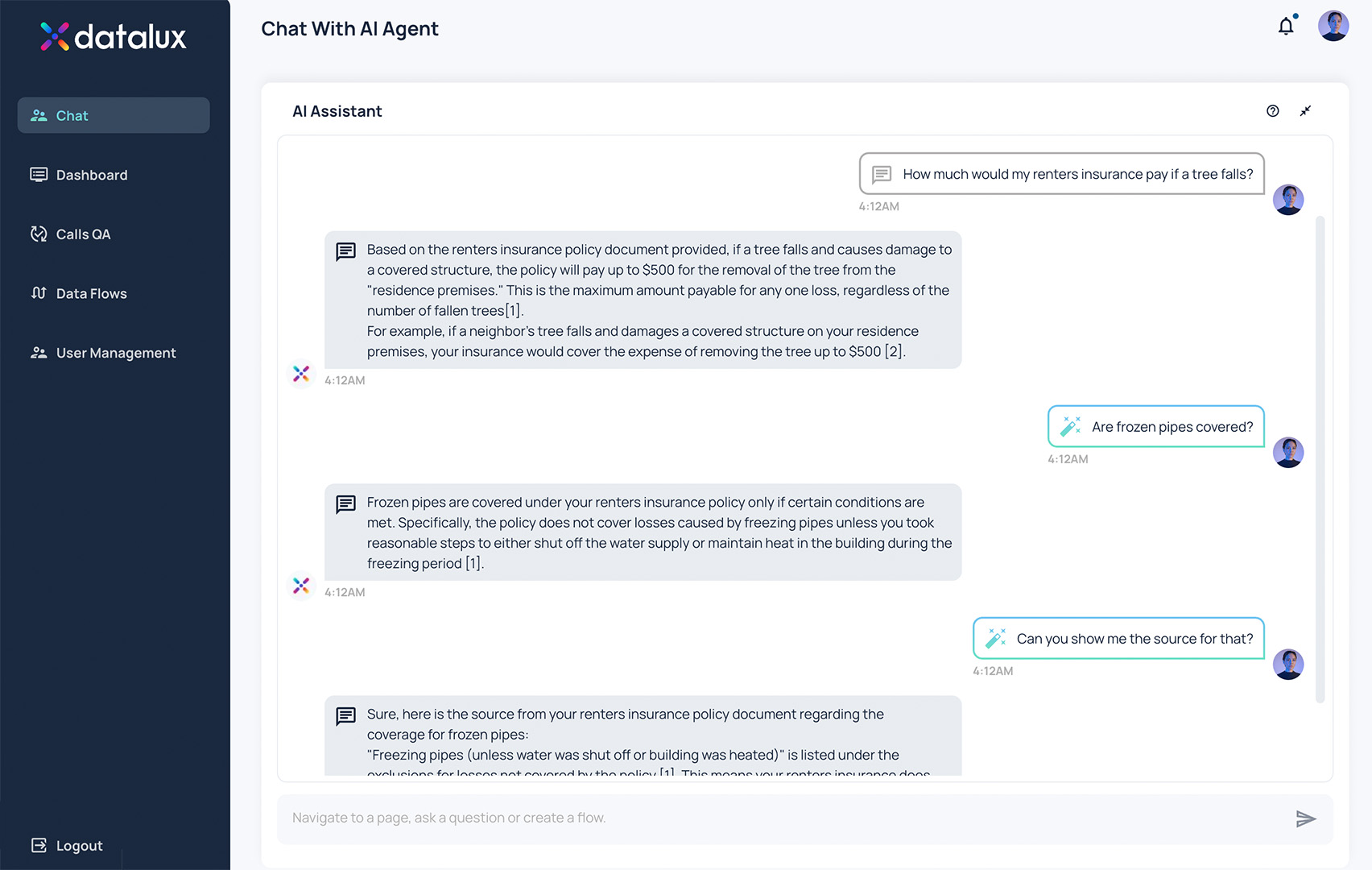
Built by DataLux · applied AI capability, not a claimed client agent deployment
03 / PROVE
Define useful behavior in terms of the business workflow. Evaluate representative cases, inspect failures and costs, and make production releases observable, reversible and supportable.
AN ILLUSTRATIVE WORKFLOW
An agent might help investigate an exception. It should not bypass the rules that protect the underlying transaction system.
This scenario illustrates a delivery pattern. It is not presented as a DataLux customer project, financial outcome or existing product feature.
Access authorized transaction records, reports and relevant documents.
Use AI to identify possible causes and point to supporting evidence.
Run deterministic rules before any proposed transaction change.
Obtain the required approval, write through an authorized API and capture the outcome.
Measure investigation effort, recommendation accuracy, exceptions and review outcomes against the customer's baseline.
WHY DATALUX
Financial rules, distributed services, data quality and operational failures aren't new territory for our senior engineers. We bring that experience to AI-enabled workflows.
Explore our selected workHOW WE WORK
A forward-deployed model with defined ownership and a measurable handoff.
Map the workflow, its owner, existing systems and acceptance criteria. Challenge whether AI is the right tool.
Integrate services, data, agent behavior and controls in short increments with your team.
Exercise representative cases, permissions and failure paths; deploy with tracing and fallback.
Deliver code, tests, runbooks and clear ownership. Extend only when further workflows justify it.
TECHNOLOGY & ARCHITECTURE
We work with established application, data and cloud systems and select agent tooling according to the customer's requirements.
OpenAI · Anthropic Claude · LangChain / LangGraph and other suitable agent frameworks
Java / Spring · Python · REST APIs · MCP patterns · Kafka · enterprise identity
AWS · GCP · PostgreSQL · streaming pipelines · existing data warehouses
CI/CD regression checks · tracing · observability · LangSmith, Langfuse or Temporal where appropriate
Named tools illustrate relevant options, not claims of official partnership, certification or previous client delivery with every platform. Architecture and hands-on capabilities are confirmed per engagement.
WAYS TO ENGAGE
Bring us a business workflow, an existing AI prototype or a product needing a new AI-assisted capability. We help define a sensible first scope, engineer the integration, evaluate it and transfer ownership.
Discuss a workflowKeep ownership of the platform and client relationship. DataLux can contribute a bounded financial-systems, backend, data or production-engineering workstream alongside your deployed engineering team.
Explore co-deliveryFREQUENT QUESTIONS
Scope, platform choice, access and acceptance criteria should be clear before engineering starts.
Senior engineers work directly with business and technical stakeholders, design and write the implementation, then help take it into production and hand over something the organization can operate. It describes how we work, not a specific platform.
Not necessarily. We start with the current stack, data access and workflow. A simple deterministic service can be preferable to an agent. Where an agent helps, we select frameworks to fit the requirements.
Yes. We can discuss a specialist integration workstream under the current program, with clear responsibility for APIs, backend services, data, controls, tests and handover. Scope and commercial arrangements are agreed with the prime team.
We design within agreed enterprise access boundaries, use least-privilege tool permissions, validate sensitive actions against deterministic rules, and introduce human approval where appropriate. Security and data-handling obligations are established during scoping.
Choose a bounded workflow and measurable acceptance criteria: coverage of expected cases, correctness, exception rates, reviewer effort, latency, operating cost and safe fallback behavior. Evaluation uses representative scenarios rather than demo impressions.
BRING US THE REAL WORKFLOW
Tell us which systems it needs to cross, who owns the decision and where implementation is stuck. We'll work out whether DataLux is the right engineering fit.
An initial conversation, not a commitment to a platform.